Most manufacturing teams have never totaled the true cost of a bad fixture decision. If they did, they’d stop shopping on unit price alone.
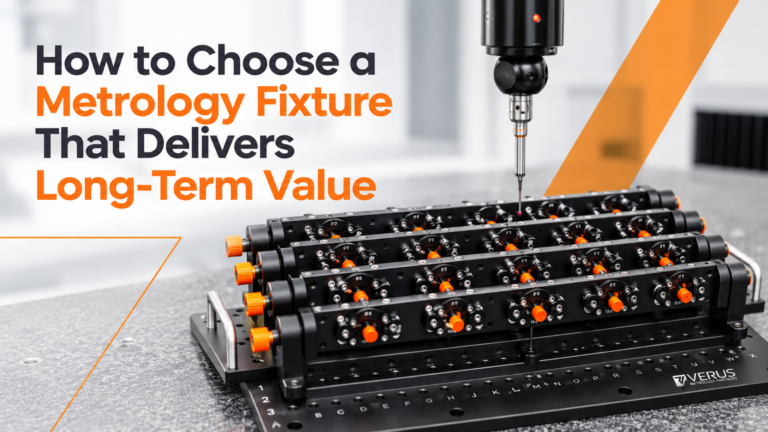
A fixture isn’t a line item. It’s a decision that either protects your measurement integrity for the next five years, or quietly erodes it starting month one.
At Verus Metrology Partners, we build fixtures once, to last, to spec, so you’re not back at square one when volumes shift, tolerances tighten, or your CMM standard changes. Here’s why that matters more than the quote price ever will.
The Real Cost of Getting It Wrong
A poorly designed or manufactured fixture doesn’t fail loudly. It fails quietly, showing up as:
- Measurement drift you don’t catch until a client audit does
- Rework and scrap from inconsistent part positioning
- Downtime while a “quick fix” fixture gets redesigned mid-production
- Compliance exposure in regulated sectors (medtech, aerospace, automotive), where non-conformance isn’t a paperwork issue. It’s a recall risk
None of that shows up on the original quote. All of it shows up on the P&L.
Buy Once Is a Methodology, Not a Slogan
Buy-once doesn’t mean spending more up front for the sake of it. It means engineering the fixture correctly the first time, so you’re not paying for it twice.
In practice, that looks like precision and stability engineered in from day one, eliminating the movement or instability that creates measurement variability down the line. It means material selection matched to the application, not the cheapest option that happens to fit. It means designing for your actual production environment, not stretching a generic template to cover your parts. And it means validating every fixture through Gage R&R and CMM verification before it ever reaches your floor.
The result is a fixture that performs consistently for years, not one that needs “adjusting” within the first six months.
The ROI Case Your Finance Team Will Actually Understand
This is the conversation worth having internally, and the one we’d challenge you to run the numbers on before your next budget cycle.
A fixture built right amortizes its cost across years of reliable use, not a single production run, which lowers your cost per measurement over time. Well-designed fixtures also speed up loading, unloading, and multi-feature measurement without repositioning, cutting setup and cycle time. And because a single recall or regulatory finding costs far more than the price difference between a discount fixture and a properly engineered one, fewer compliance incidents alone can justify the investment. Add it up and you get something rare in capital planning: predictable long-term spend, with no surprise re-quotes when a “budget” fixture doesn’t hold up to real production conditions.
If your current fixture supplier can’t show you data on fixture longevity, repeatability, or total cost of ownership, that’s the question to ask them next.
What This Looks Like at Verus
We’re ISO 9001, ISO 17025, and ISO 13485 accredited, built for regulated industries where “close enough” isn’t a defence. CMM programming, CT scanning, and automated inspection all sit under one roof, so your fixture strategy and your inspection strategy are never disconnected. Our design process is collaborative from the start: we work from your part geometry, tolerances, and production reality, not a generic catalogue entry. And we’ve built that track record with medtech and industrial leaders who don’t tolerate measurement uncertainty, because they can’t afford to.
The Real Question to Ask Yourself
Is your current fixture strategy actually saving you money, or just deferring the cost to a future quarter, a future audit, or a future recall?
If you’re not confident in that answer, it’s worth 30 minutes to find out. Let’s put your current fixture spend under the same scrutiny we’d apply to a new project. Bring your current fixture quotes or pain points, and we’ll show you the gap in real terms.